A Day in the life of a beachcomber
Sea Glass Hunting at Pentewan Beach, Cornwall
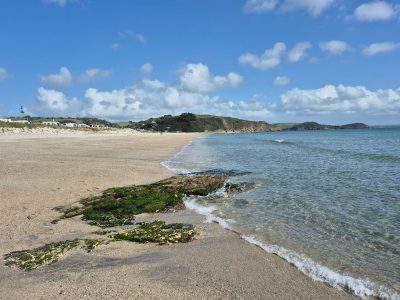 Here in Cornwall, we’re lucky to have some wonderful sea glass hunting spots, and Pentewan Beach, near St Austell, is one that many collectors will already know. Pentewan is a beautiful, privately managed beach sitting alongside the popular Pentewan Sands Holiday Park. It has a lovely sheltered feel, beautiful clean sand and, during the summer months, dogs aren’t permitted on the beach.
For a beachcomber, it sounded like the perfect place to spend a few hours searching for Cornwall sea glass. I have never been before so I arrived with high hopes. But, as it turned out, Pentewan had a few surprises waiting for me.
My first reaction when I arrived was actually one of disappointment. It seemed that there was some very new-looking glass across parts of the beach. From what I could see, there appeared to have been some deliberate seeding of glass.
The controversial practice of sea glass seeding
This a subject within the sea glass collecting community that can spark quite a debate. For those unfamiliar with the term, seeding is the deliberate act of placing glass, marbles or even whole bottles into the sea, with the hope that the waves will eventually tumble them into something resembling naturally weathered sea glass. The idea is that someone, perhaps years down the line, will stumble across these planted treasures while beachcombing.
Obviously, I can understand the appeal of finding a beautiful piece of sea glass, particularly a rare colour, but personally, I really don’t agree with this practice.
For me, one of the most fascinating aspects of sea glass hunting is the history behind each piece. I love wondering where a fragment came from, how old it might be and what journey it has taken before eventually washing up on the shore. There’s something rather special about finding a piece that has been naturally shaped and frosted by the sea over many years.
When glass is deliberately introduced to a beach, that natural history is lost. A beautifully frosted piece might look like a genuine find, but it could simply be the result of someone deliberately planting glass for collectors to discover.
And then there’s the environmental aspect. Our beaches and oceans already have enough rubbish without people deliberately adding more. Glass may be relatively inert, but that doesn’t make it harmless to introduce into the marine environment, particularly when it may be sharp or pose a hazard to animals and beach users.
The best sea glass was at the far end of the beach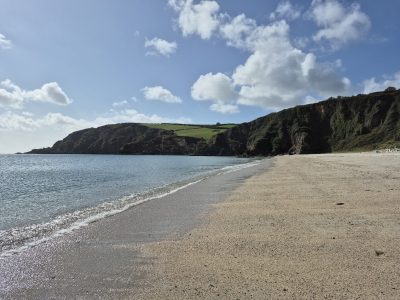
Rather than giving up, I decided to keep walking. And I’m so glad I did. The far end of Pentewan Beach was where things became much more interesting. Away from the areas with the newer-looking glass, I started finding pieces that had much more of the character I was hoping for.
Frosted surfaces. Softened edges. That unmistakable look of genuine sea glass. And then, completely unexpectedly, I found two of the most amazing pieces I’ve ever picked up while beachcombing in Cornwall.
A beautiful blue teardrop-shaped piece
The first was a stunning blue teardrop-shaped piece of sea glass.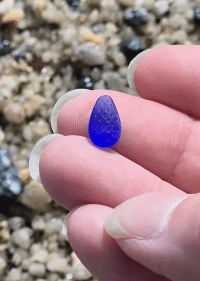
Blue sea glass is always a favourite of mine, but this particular piece was something really special. The shape immediately caught my attention, but when I picked it up and turned it over, I noticed the most incredible pattern running across the glass.
It’s difficult to explain that feeling when you find something genuinely unusual. You can walk for miles along a beach and pick up dozens of pieces, but every now and then you spot something that makes you stop in your tracks. This was one of those pieces.
My unexpected two-tone sea glass find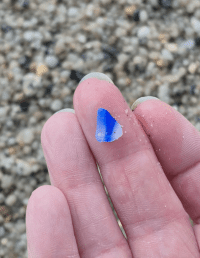
And then came the second piece. A two-tone piece of sea glass. I honestly never thought I’d find something like this in this area.
The combination of colours immediately reminded me of some of the incredible sea glass pieces associated with Seaham in the North East of England. Seaham is famous amongst sea glass collectors for its exceptional and unusual finds, particularly multi-coloured and highly distinctive pieces, so finding something with that kind of appearance here in Cornwall was a real surprise.
Two pieces that aren’t becoming jewellery
As much as I love turning beautiful sea glass into sea glass jewellery, some pieces are simply too special to let go.
These two definitely fall into that category.
The blue patterned teardrop and the incredible two-tone piece will both be going straight into my permanent sea glass collection. They are exactly the kind of pieces I beachcomb for. Not necessarily the biggest pieces. Not necessarily the rarest colours. But pieces that have something about them that makes them completely different from everything else you’ve found. And these two certainly do.
Is Pentewan Beach worth visiting for sea glass?
Absolutely — but with realistic expectations.
If you’re hoping to go sea glass hunting in Cornwall, Pentewan Beach is certainly worth exploring. It’s a beautiful clean beach and, as I’ve discovered, there are some genuinely spectacular pieces to be found.
However, don’t expect every piece you see to be naturally weathered sea glass. If you do find newer, sharp glass that has been left on a beach please do pick it up and discard it at home, so its not a danger to other beach users.