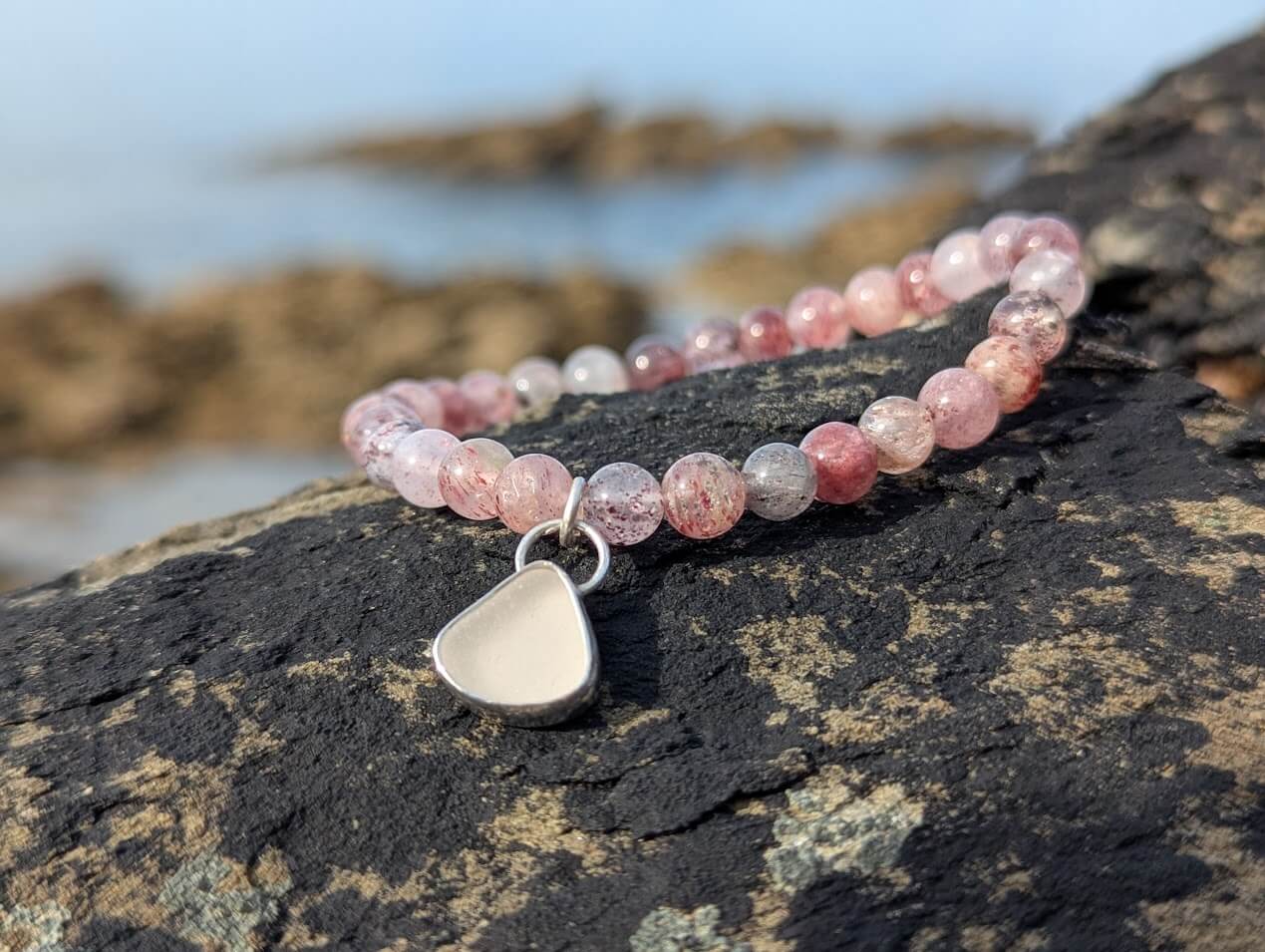
How to identify authentic sea glass from fake tumbled glass?
If you’ve ever searched for sea glass jewellery online, you’ve probably noticed an incredible variety of colours, shapes, and prices. Unfortunately, not all “sea glass” is created by the sea.
Over the past few years, artificially tumbled glass has become increasingly common. While there’s nothing inherently wrong with crafted or recycled tumbled glass when it’s sold honestly, it can be misleading when it’s advertised as genuine sea glass.
As someone who has spent many years walking the rugged Cornish coastline in search of these little treasures, I wanted to share what makes authentic sea glass so special—and how you can tell the difference.
What Is Genuine Sea Glass?
Authentic sea glass begins its life as ordinary glass—perhaps from an old bottle, a jar, a shipwreck, or even long-forgotten household glass discarded and found its way into the sea.
Over many years, sometimes even decades, the sea slowly transforms it. Waves, sand, shingle, and time work together to smooth the sharp edges, soften the surface, and create the beautiful frosted finish that sea glass collectors know and love.
Every genuine piece has survived a remarkable journey. No two pieces are ever exactly alike.
What Is Artificially Tumbled Glass?
Artificial sea glass is usually made by placing modern glass into a rock tumbler along with abrasive grit and water. Within a matter of hours or days, the glass develops a frosted appearance and rounded edges that resemble naturally weathered sea glass.
Many jewellery makers use tumbled glass openly and honestly, describing it as “cultured,” “crafted,” or “machine-tumbled” sea glass. There’s absolutely nothing wrong with this.
The problem arises when machine-tumbled glass is marketed as naturally found sea glass, giving buyers the impression that each piece has spent years in the ocean.
How to Spot Genuine Sea Glass
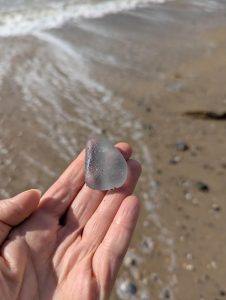 Although it takes practice, there are several clues that can help you identify authentic sea glass.
1. The Frosting
Real sea glass has a soft, naturally weathered appearance. The frosting is usually uneven, with subtle variations across the surface created by years of exposure to the elements.
Artificially tumbled glass often has a more uniform, consistent finish that can look slightly too perfect.
2. The Shape
The sea doesn’t work to a timetable or a template.
Natural sea glass comes in wonderfully irregular shapes. Some pieces are rounded, others angular, and many have tiny dips, curves, or unusual contours that reflect the original object they came from.
Machine-tumbled pieces are often suspiciously smooth and evenly rounded.
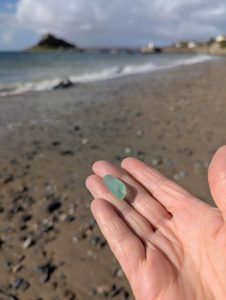 3. Tiny “C” Marks
One of the classic signs of genuine sea glass is the presence of tiny crescent-shaped marks, sometimes called “C” marks. These microscopic patterns are created over years as glass repeatedly rubs against sand and pebbles in the surf.
They’re difficult to reproduce convincingly in a tumbler and are often absent from artificial glass.
4. Natural Wear
Authentic sea glass often has slight imperfections.
You may notice small pits, subtle texture changes, tiny scratches beneath the frosted surface, or gentle variations that tell the story of its time in the sea.
These are part of its character—not flaws.
5. Rare Colours
Some colours are naturally much rarer than others.
White, green and brown are relatively common because they came from everyday bottles.
Colours such as red, orange, turquoise, teal, purple and yellow are genuine treasures and are found far less frequently.
If you see a seller offering hundreds of identical bright blue, vivid red or perfectly matching turquoise pieces, it’s worth asking where the glass came from.
Nature rarely produces large matching batches.
Why Authentic Sea Glass Matters
For many collectors and jewellery lovers, the appeal of sea glass isn’t simply its appearance.
It’s the story.
Each piece has spent years, often decades, being shaped by the ocean before eventually washing ashore to be discovered by chance. Every fragment is unique, carrying its own history that can never be repeated.
That journey is something no machine can recreate.
My Own Sea Glass Journey
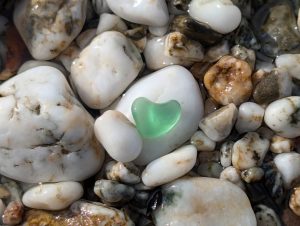 For many years I’ve explored the beaches and coves of the Cornish coast, searching tide lines after storms, walking countless miles in every season, and patiently collecting one piece at a time.
Some days I return home with only a handful of small finds. Occasionally, after hours of searching, I find nothing at all.
That’s part of what makes genuine sea glass so special.
Every piece I use in my jewellery has been personally beachcombed by me along the Cornish coastline. I never buy bulk sea glass, and I never use artificially tumbled glass.
When you choose one of my pieces, you’re not just buying jewellery—you’re owning a genuine piece of the Cornish coast, shaped by nature and time before being carefully handcrafted into something that can be treasured for years to come.
Thank you for supporting authentic craftsmanship and helping to preserve the story behind every piece of genuine sea glass.